


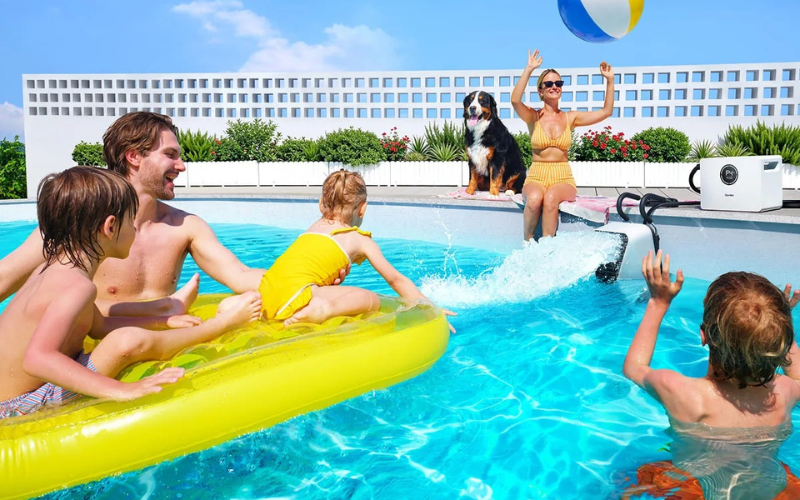
A vacation home or rental pool can be a great place to stay active. The problem is that most residential pools are not designed for serious lap swimming.
They may be too short. They may have steps at one end. The shape may also make traditional laps awkward.
Permanent modifications are usually not a good solution. You may not own the property. Even if you do, you may only use the pool for part of the year.
A temporary swim lane offers another approach.
With the right setup, you can create a useful training area without rebuilding the pool.
Start With the Longest Clear Section
Before adding any equipment, look at the pool layout.
Find the longest clear path through the water.
Avoid areas with large steps, benches, tanning ledges, or ladders. These features reduce usable space and can disturb water movement.
A rectangular pool makes this simple.
In a freeform pool, the best swimming line may run slightly away from the center.
You do not need an official lap lane. You only need enough clear water for your body to move naturally.
Try to leave open space on both sides of the swimmer.
Do Not Make Permanent Changes to a Rental Pool
If the pool belongs to a rental property, avoid drilling or modifying the pool structure unless you have clear permission.
Do not assume a small mounting hole is acceptable.
Pool coping, decking, plumbing, and electrical systems are part of the property.
A temporary setup should be removable.
The ideal arrangement leaves the pool in the same condition after you take the equipment away.
This is one reason portable resistance equipment works well for vacation properties.
You can use it during your stay and store or remove it afterward.
Decide Between a Tether and Moving Water
A swim tether is the simplest temporary solution.
It attaches the swimmer to a secure point with a resistance cord. You swim forward while the tether holds you in place.
This requires very little equipment.
However, the resistance comes from behind your body. Some swimmers find that this changes body position and stroke feel.
A portable current system works differently.
It moves water toward you. You swim against the current without being attached to a cord.
This can feel closer to normal continuous swimming.
The better choice depends on how often you train and how natural you want the swimming motion to feel.
Choose a Portable System That Can Leave With You
For a vacation property, portability should mean more than simply being smaller than a permanent system.
You should be able to set the equipment up without construction.
You should also be able to remove it without leaving permanent hardware behind.
The iGarden Swim Jet X Series is one option designed for this type of situation. It uses a clamp-style pool-edge setup rather than a permanent built-in installation, making it relevant for pools where structural changes are not desirable.
This approach also gives you more freedom if you use several pools during the year.
Match the Model to the Trip
You do not necessarily need the highest-output model for a temporary pool.
If the vacation pool is mainly used for light exercise, the X AIR can be a practical choice. It is positioned for lighter use and beginner practice.
The X 5 makes more sense for regular swimmers who want steady fitness sessions. It offers a middle ground for technique and continuous training.
For stronger swimmers who want demanding intervals, the X PRO 10 is the more performance-focused choice. It is designed for higher-intensity training and offers the longest listed runtime in the range.
Your choice should reflect how you actually plan to use the pool.
Check the Pool Edge Before Setup
A portable system still needs a suitable mounting area.
Look at the pool edge carefully.
The surface should be stable. Avoid damaged coping or loose materials.
You should also check whether unusual ledges or raised walls interfere with the mounting position.
Do this before traveling with the equipment if possible.
Photos and measurements can help.
If you are staying at a rental property, ask for basic pool dimensions before the trip.
This can prevent you from arriving with equipment that does not suit the pool.
Create a Clear Swimming Zone
Once the current system is in place, remove unnecessary objects from the lane.
Move floating toys away.
Keep cleaning hoses and pool accessories out of the training area.
Make sure ladders do not interfere with your arms.
The swimmer should have enough room to move forward, backward, and slightly sideways.
A current does not keep you in one exact point.
Small movements are normal.
A little extra clearance makes the experience much more comfortable.
Test the Current Before Starting a Workout
Do not start at maximum resistance.
Begin with a low setting.
Swim for a few minutes and notice where your body naturally holds position.
You may need to move slightly closer to or farther from the current source.
Then increase resistance gradually.
Watch how the water behaves near the walls.
If the pool is short, returning water may create more turbulence at higher settings.
A moderate current may feel better than maximum output in a compact rental pool.
Make Removal Part of the Plan
A temporary swim lane should be easy to remove.
After your final workout, allow the equipment to drain.
Wipe away excess water and inspect it for leaves or debris.
If you have used the system in a saltwater pool, follow the manufacturer’s care guidance before storage.
Keep small accessories together.
A dedicated storage bag or container can make transport easier.
This is especially useful if the equipment moves between your primary home and a vacation property.
Temporary Does Not Have to Mean Basic
A rental or vacation pool does not need to become a permanent training facility.
It only needs a clear swimming zone and a resistance method that suits your goals.
For occasional exercise, a tether may be enough.
For swimmers who want continuous resistance without being physically attached to the pool, a portable current system can create a more natural training environment.
The important part is keeping the setup reversible.
Choose a clear lane. Avoid permanent construction. Match resistance to the available pool space. Remove the equipment when the stay or swimming season ends.
With that approach, even a temporary backyard pool can become a useful place for regular swim training.