


By Drake Miller – Senior Content Manager and Academic Strategy Consultant
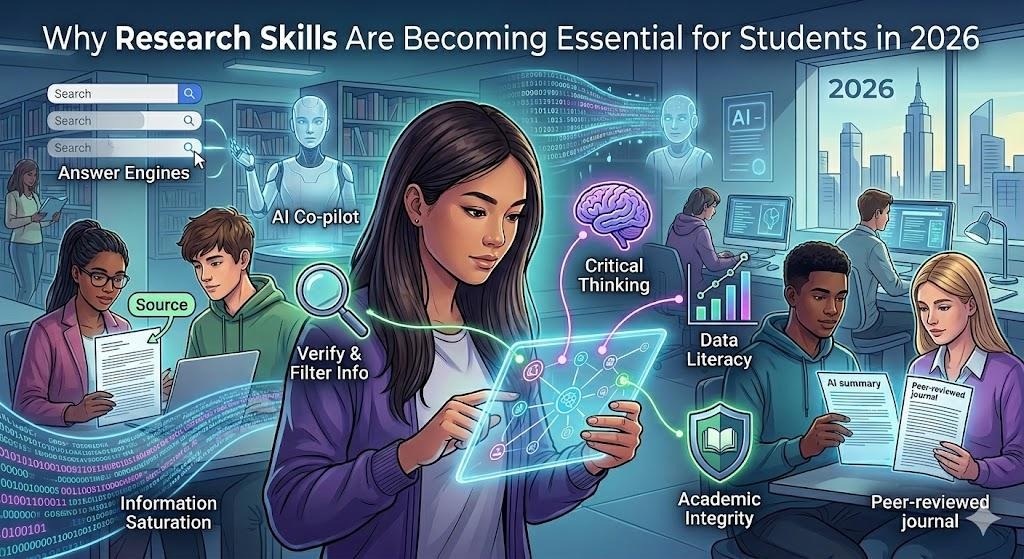
The academic landscape of 2026 is fundamentally different from that of even five years ago. We have moved past the era of “information scarcity” and deep into the era of “information saturation.” For high school and university students, the challenge is no longer finding information—it is filtering, verifying, and synthesizing it.
As Artificial Intelligence (AI) becomes a standard co-pilot in classrooms, the value of a student is no longer measured by what they can memorize, but by the quality of the questions they ask and their ability to validate the answers they receive. This is why research skills have transitioned from being a “niche academic requirement” to an essential survival skill for the modern student.
The Evolution of Information in 2026: From Search Engines to Answer Engines
In the early 2020s, students “Googled” their way through assignments. In 2026, the primary interface for information is generative AI and sophisticated answer engines. While these tools provide instant gratification, they also introduce significant risks: algorithmic bias, data hallucinations, and the “echo chamber” effect.
Research skills are the only defense against these digital pitfalls. A student with strong research capabilities understands that an AI-generated summary is a starting point, not a final product. Whether a student is looking for a professional to write my assignment to understand complex structures or tracing a claim back to its primary source, they must know how to identify the methodology of a study and discern between peer-reviewed evidence and AI-generated misinformation.
1. Navigating the “Deep Web” and Academic Databases
For high school seniors and college students, relying on the surface web—what shows up in a standard search—is no longer sufficient for high-level academic work. In 2026, the volume of AI-generated “noise” on the public internet is at an all-time high. To stand out, students must master academic databases such as JSTOR, PubMed, or specialized repositories.
Knowing how to use Boolean operators, understanding citation indices, and navigating paywalled academic journals are skills that separate an average student from an exceptional one. This technical proficiency extends to STEM fields as well; for example, a computer science student might choose to do my coding assignment through a specialized service to see how experts structure clean, scalable code. When students leverage professional support systems—for instance, seeking expert academic mentorship through Myassignmenthelp.com for guidance on complex methodology—they learn that high-quality research is a collaborative and structured process.
2. Critical Thinking in the Age of Synthetic Media
We are living in an age where “Deepfakes” and synthetic text are indistinguishable from reality to the untrained eye. Research skills in 2026 are synonymous with digital literacy. Students are now required to perform “lateral reading”—the practice of leaving a website to see what other digital sources say about that site.
This critical evaluation prevents students from citing “hallucinated” facts or biased data sets. In 2026, research is as much about disproving false claims as it is about proving a thesis. This skepticism is a core component of the scientific method and is now a prerequisite for social sciences, humanities, and even creative arts.
3. Data Literacy: The Language of the Future
Modern research is increasingly quantitative. Whether a student is studying history or physics, they are likely to encounter large data sets. The ability to interpret a graph, understand statistical significance, and recognize when data is being manipulated is vital.
In 2026, “research” includes knowing how to use data visualization tools and basic statistical software. Students who can curate their own data rather than relying on second-hand interpretations will find themselves at a massive advantage in the college admissions process and the competitive US job market.
4. The Ethical Dimension: Originality and Academic Integrity
With the ease of “Copy-Paste-AI,” the temptation to bypass the research process is high. However, educational institutions in 2026 have implemented sophisticated “Proof of Process” requirements. Students are often required to show their research trail—the evolution of their notes, the sources they discarded, and the drafts they built.
Developing research skills fosters a sense of intellectual ownership. When a student spends hours tracking down an obscure primary source, they are less likely to engage in plagiarism. They understand the value of intellectual property and the importance of giving credit where it is due.
5. Bridging the Gap: High School to Higher Education
One of the biggest “shocks” for first-year university students is the leap in research expectations. High school often rewards “finding the right answer,” whereas university rewards “exploring the complexity of the question.” In the USA, mastering these skills early is essential for success in Advanced Placement (AP) courses and the AP Capstone diploma, which specifically rewards independent research capabilities.
By mastering research skills early, high school students bridge this gap. They learn that a “perfect” source doesn’t exist; instead, they learn to synthesize multiple perspectives to build a nuanced argument. This preparation reduces the high stress and burnout rates often seen in college freshmen who feel overwhelmed by independent research projects.
6. Career Readiness: Research as a Marketable Skill
Beyond the classroom, the professional world of 2026 prizes “Information Architects.” Whether in marketing, engineering, or law, employers are looking for individuals who can:
- Identify emerging trends through market research.
- Conduct competitive analysis.
- Verify the accuracy of technical reports.
- Synthesize vast amounts of data into actionable insights.
The research paper you write in 12th grade or your sophomore year of college is essentially a simulation of a professional white paper or project proposal. Mastering the “boring” parts of research—the citations, the bibliography, the literature review—is actually training for high-level executive functions.
How to Enhance Your Research Skills in 2026
If you are a student looking to sharpen your edge, consider these three pillars of modern research:
- A. Mastering the Prompt, then Validating the Result: Use AI to brainstorm keywords and structure, but never as the final authority. Once you have a lead, use traditional library resources to verify the “facts.”
- B. Organizing Your Digital Library: Use tools like Zotero, Mendeley, or Notion to organize your sources. A researcher is only as good as their filing system.
- C. Seeking Expert Mentorship: Research is a craft. Utilizing academic assistance services can provide a template for how a well-researched paper should look, helping students understand the standard of evidence required at the university level.
Conclusion: The Ultimate Competitive Advantage
As we look toward the remainder of the decade, the “A” student will not be the one with the fastest typing speed or the best AI prompting skills. The “A” student will be the one who knows how to dig deeper. Research skills empower students to be creators of knowledge rather than just consumers of content. They provide the tools to navigate a complex, often confusing digital world with confidence and clarity.
For students aiming for the top universities in the USA and beyond, there is no shortcut. Investing in your ability to find, analyze, and apply information is the best investment you can make in your future.
Frequently Asked Questions
Q.1 How do I cite AI-generated content in 2026?
Most US universities now require specific AI-disclosure statements. You should cite the tool used, the date of the prompt, and include the prompt text in your appendix to maintain transparency.
Q.2 What are the best academic databases for US high schoolers?
JSTOR and Google Scholar remain staples, but many US school districts now provide access to specialized repositories like EBSCOhost and Gale for AP-level research.
Q.3 Are “Research Copilots” considered cheating in US colleges?
Not necessarily, but usage must align with your specific university’s Honor Code. In 2026, most institutions distinguish between Administrative AI (using tools to organize citations or suggest keywords) and Substantive AI (generating the actual thesis or analysis). Always check your syllabus; when in doubt, include a “Methodology Note” explaining which tools assisted your process.
About the Author
Drake Miller is a Senior Content Manager and Academic Strategy Consultant with over 12 years of experience in higher education and digital strategy. Based in London and Sydney, Drake specializes in developing student success guides that bridge the gap between emerging technology and traditional academic excellence.