


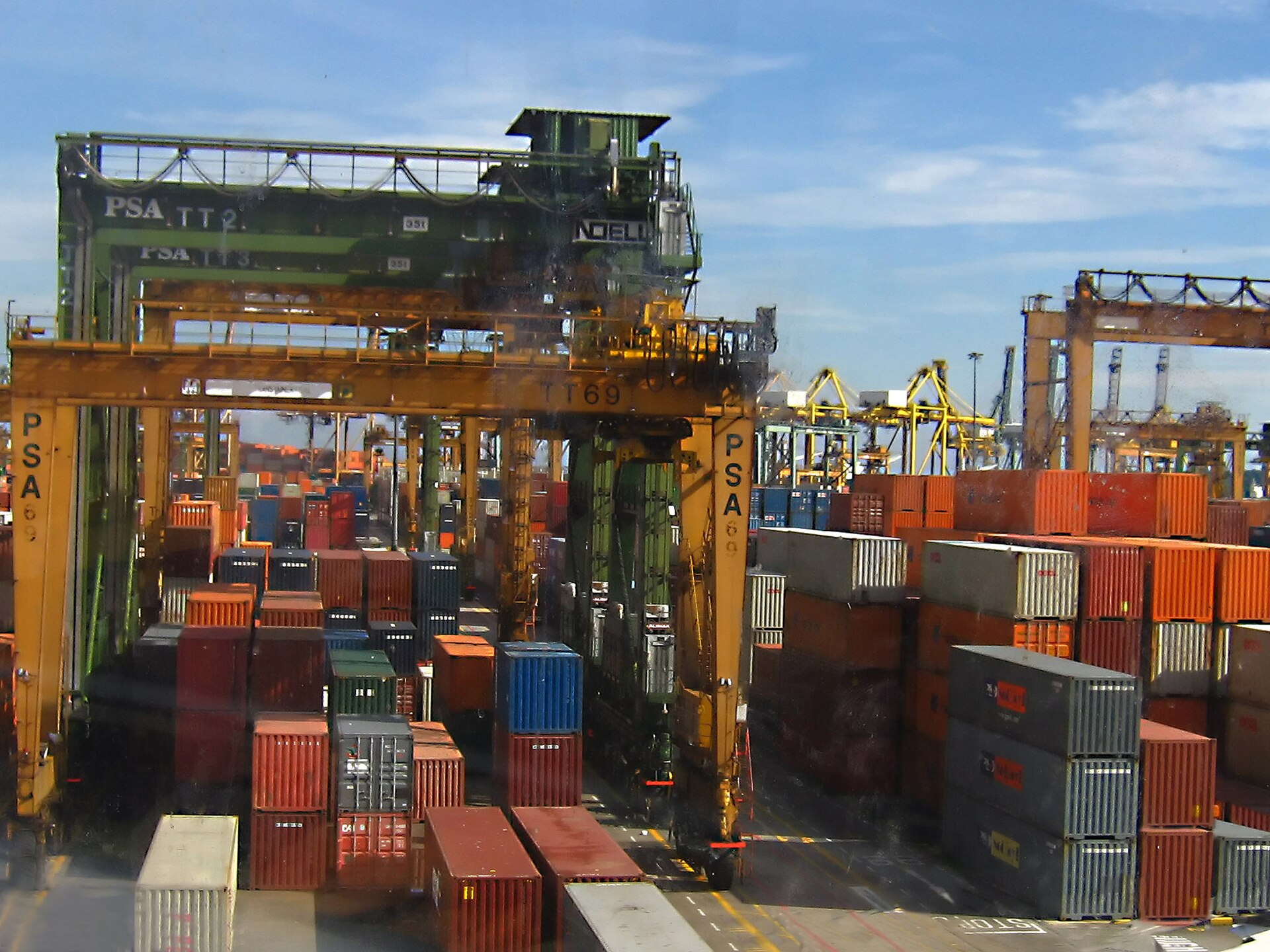
Singapore handles roughly a sixth of the world’s container transshipment, and it is rebuilding that empire on a single site. Tuas Port, rising on reclaimed land at the island’s western edge, will consolidate the city terminals into one mega-port with a planned capacity of 65 million containers a year — the largest fully automated terminal complex on Earth when complete. The first berths are already operating: driverless vehicles glide containers between quay and yard, cranes are piloted remotely from control rooms, and the whole ballet is orchestrated by software rather than shouted across a dock.
The strategic logic is pure Singapore. Land is the scarcest resource, so the port consolidates; labour is scarce, so the port automates; and competition — from Malaysia’s expanding ports and a possible Thai land bridge — is answered with a facility designed to be too efficient to route around. The Maritime and Port Authority of Singapore frames Tuas as a forty-year asset: phased through the 2040s, electrified, and built to handle the largest vessels afloat. Shipping lines get a single mega-hub; Singapore gets to remain the fulcrum of Asian trade for another generation. Analysts at the World Bank, whose port performance index Singapore routinely tops, treat the project as the benchmark others will be measured against.
The Workforce Question, Answered in Advance
Automation at a port that employs tens of thousands arrives with a social contract attached. The model Singapore publicises — and unions have negotiated into the plan — is transition rather than replacement: crane drivers become remote operators supervising multiple cranes; vehicle mechanics become fleet technicians for electric AGVs; the workforce shrinks by attrition and retraining rather than by layoff waves. Whether the template exports is another matter, but it is the most serious attempt anywhere to automate a port with its workers rather than despite them. Our Asia business desk follows the build in our Asia coverage.
Infrastructure as Identity
The Port as a Software Company
Walk the automated terminal and the surprise is how little there is to see: the cranes move like weather, the yard runs itself, and the humans are in a control room that resembles a trading floor. The port of the future is a software company that happens to move boxes — its competitive assets are the scheduling algorithms, the digital twin that rehearses tomorrow’s traffic tonight, and the data standards that let a container’s paperwork clear three jurisdictions before the ship berths. Singapore’s bet is that this software layer, exported to ports it advises and operates abroad, outearns the physical one. Rivals are automating too, from Rotterdam to Shenzhen, which is why the race is really about who writes the operating system of world trade. The container standardised the box. Whoever standardises the box’s brain collects the century’s quieter fortune.
The workforce question shadows every automated quay. The port that once employed an army of drivers, lashers and crane operators now employs control-room specialists, maintenance technicians and data analysts — fewer people, differently skilled, in a country that has made the transition a matter of national choreography: unions inside the planning process, retraining funded before the jobs change, and the new terminal’s hiring pitched at the old terminal’s staff. Whether that choreography is exportable to ports without Singapore’s labour institutions is an open question. The cranes travel well. The social contract around them is the part other ports must manufacture locally.
For a city-state whose founding story is a port, Tuas is more than logistics. It is the argument, poured in concrete and code, that a small country stays relevant by being early to the future’s infrastructure — as it was with containerisation itself in the 1970s. The cranes are rising on schedule. The bet they embody is the national one: that trade will keep flowing through whoever handles it best, and that “best” is a title you rebuild every generation or lose.
